The Ridgewalker
Cataloged from upland marginalia, surveyor’s sketches, and repeated silhouette sightings along mountain crests
Observed Name(s)
The Ridgewalker
The Antlered Watcher
Skull-on-the-Line (late frontier phrase)
“He Who Keeps the High Places” (damaged folio)
Classification
Upland Entity
Crest-Bound Sentinel
Territorial (Non-Pursuing)
Primary Domain
Mountain ridgelines and knife-edge crests
High passes, exposed spines, and long summit walks
Natural boundaries where valleys divide
Most frequently observed during low light—dawn, dusk, or heavy overcast—when distance distorts scale and silhouettes assert themselves.
Description
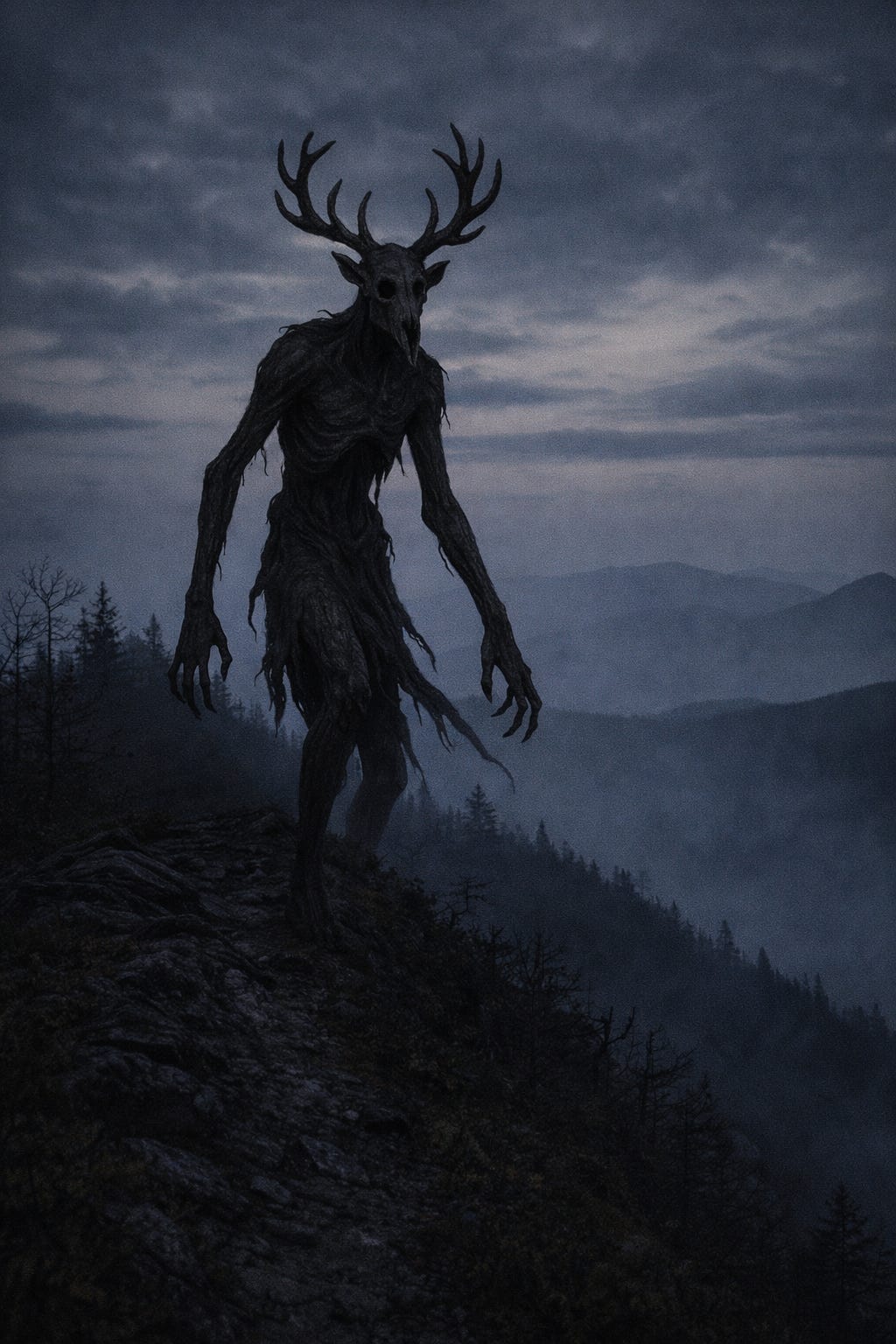
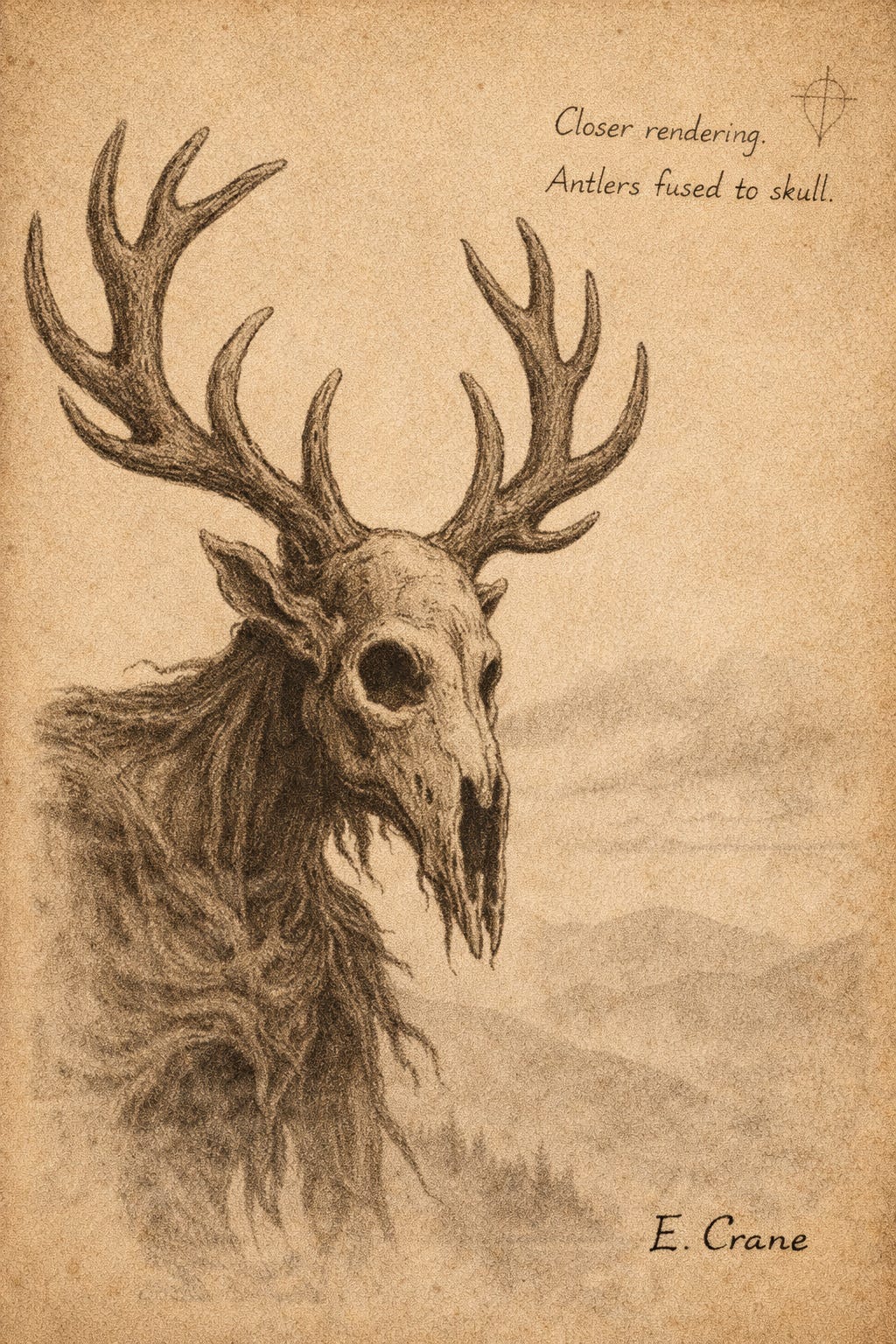
The Ridgewalker presents as a tall, emaciated, humanoid form, crowned with a bleached antlered skull—most often cervine in structure, though no identical configuration has been recorded twice. The skull appears fused rather than worn, as if grown into the figure rather than carried.
Its body is thin, sinewed, and desiccated, draped in what may be remnants of hide, bark, or wind-torn material. Limbs are elongated beyond human proportion. Hands hang low and open, fingers extended as if balancing against unseen weight.
The Ridgewalker is always upright.
It does not crouch.
It does not climb.
It is already where it must be.
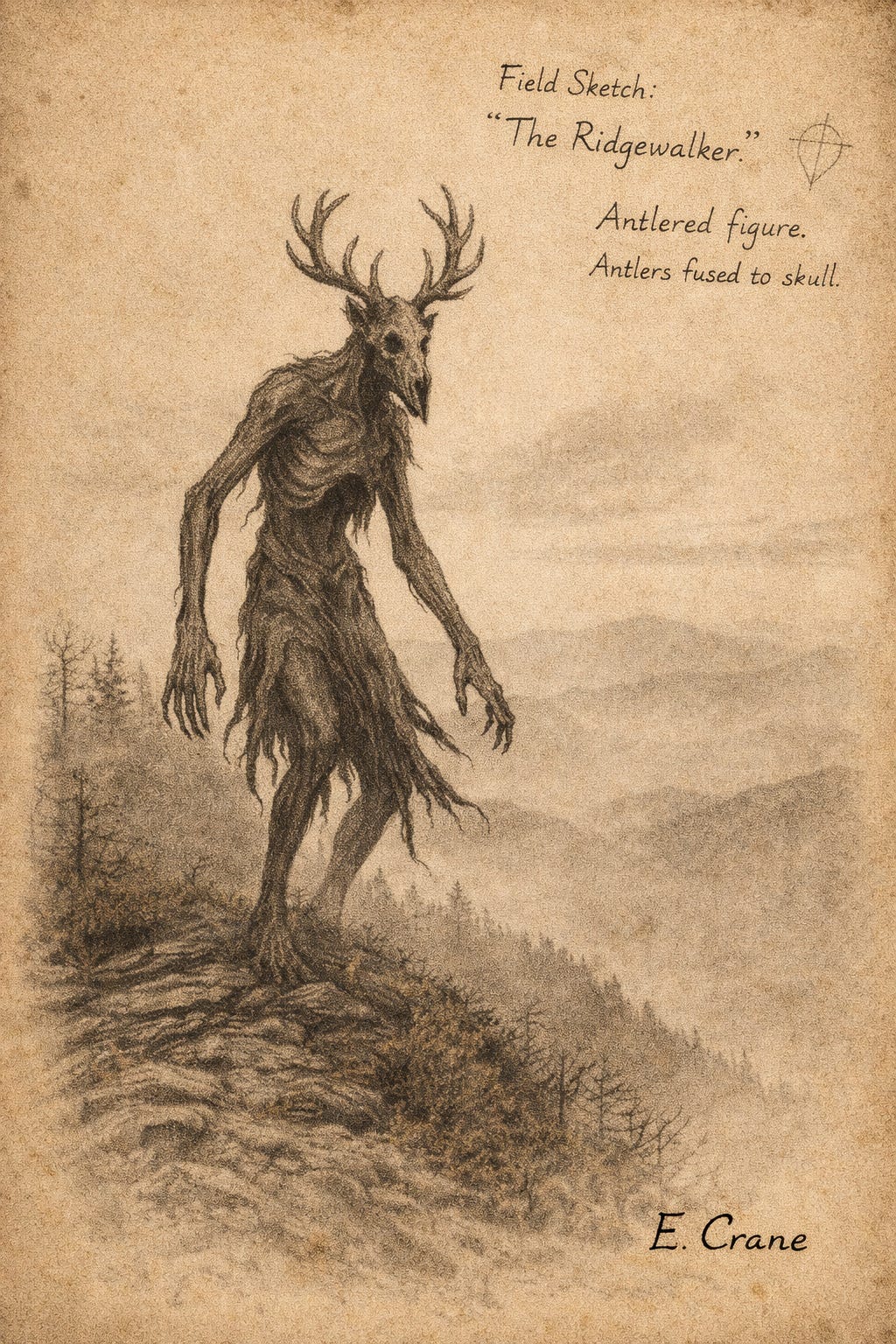
Archival Field Sketch — Antlered Silhouette
Attributed to Elijah Crane. Figure observed along ridgeline at extreme distance.
Behavior & Signs
The Ridgewalker’s presence is defined by placement, not movement.
Common indicators include:
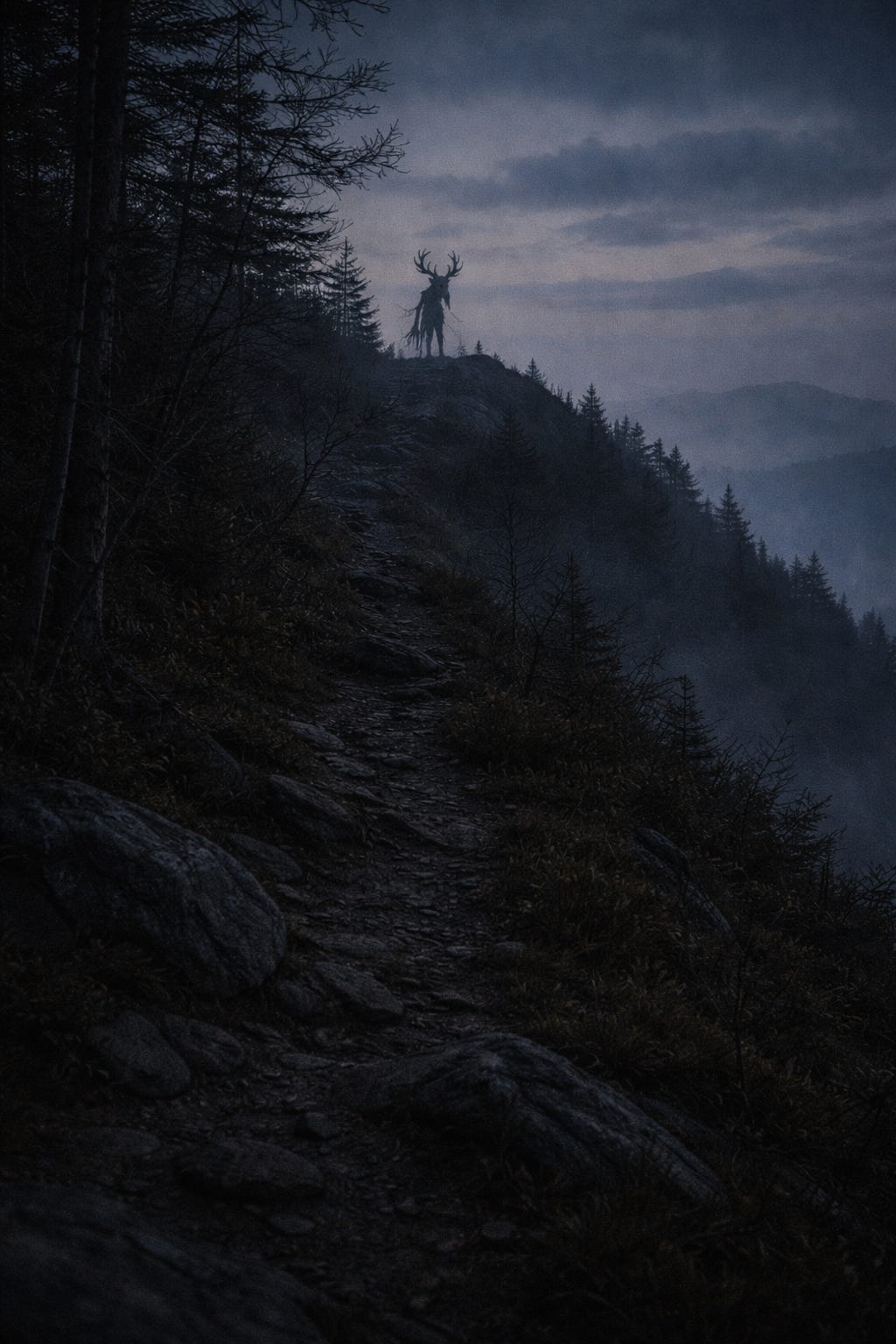
A solitary figure visible against the skyline where no trail runs
Antler-like projections interrupting the horizon line
The sensation of being “measured” while ascending
Winds that seem to rise only once the crest is reached
An abrupt urge to descend without clear reason
Observers report that the figure may shift position without being seen to move—appearing further along the ridge after moments of inattention.
Lantern light does not illuminate the Ridgewalker, though it may sharpen the outline of antlers briefly against cloud or fog.
Disposition
Territorial
Non-Communicative
Selective
The Ridgewalker does not chase.
Those who retreat are not followed.
Those who continue upward often report losing track of time, distance, or direction until descent becomes unavoidable.
Associated Lore
Crane’s later notes suggest the Ridgewalker is not bound to paths, but to the idea of elevation itself. It appears where land rises beyond habitation—where survival shifts from endurance to exposure.
A torn page from a surveyor’s ledger reads:
“He stands where the mountain ends being useful.”
Mountain folk speak of antlers marking not dominance, but claim—a sign that the high places belong to something older than roads, borders, or names.
Known Interactions
No direct communication has been recorded.
Witnesses consistently report:
A tightening in the chest near the crest
A sense that continuing upward would be an error, not a danger
The figure remaining visible until descent begins
No confirmed sightings exist below the ridgeline.
Warnings
Do not approach the silhouette.
Do not wave or signal.
Do not crest the ridge if the figure remains.
Keep to the valleys.
Crane Codex Note
Some things move through the world.
Some things wait beneath it.
And some things stand where the land itself draws a line.
ANNOTATION
Mattie Mackie
The antlers matter.
Crane never explains them, but he redraws them—again and again—altering their shape, their spread, their weight. I do not believe this was uncertainty. I believe it was recognition.
Antlers are not weapons. They are declarations.
In modern sightings, the Ridgewalker’s form has grown clearer, not closer. Cameras capture shape but not detail. The skull reads immediately as warning—not of violence, but of finality. This is as high as one is meant to go.
The Ridgewalker does not guard the mountain.
It ends it.
— M.M.